I’m sure you’re wondering what became of the twelve Kieze where “Kiezblocks” were supposed to be implemented by spring 2026, right?
After selecting the Kieze, conducting the inventory survey, engaging the community, and developing the concept drafts, the original plan was for district decision-makers to select twelve Kieze to be designated as “Kiezblocks.” The project was to be implemented as a model project for pedestrian traffic in the Mitte district pursuant to Section 58(3) of the Berlin Mobility Act, with funding from the Senate Department for Mobility, Transportation, Climate Protection, and the Environment (SenMVKU) .
However, in 2025, as the project progressed, the SenMVKU temporarily suspended funding, which meant that the funds that had been pledged for planning and public participation were no longer available (see press release dated May 15, 2025).
The “Kiezblocks für Mitte” project has been adapted to the new circumstances.
In consultation with SenMVKU, four Kiezblocks were selected where traffic-calming measures—such as one-way streets—can still be effective even without structural measures like rows of bollards.
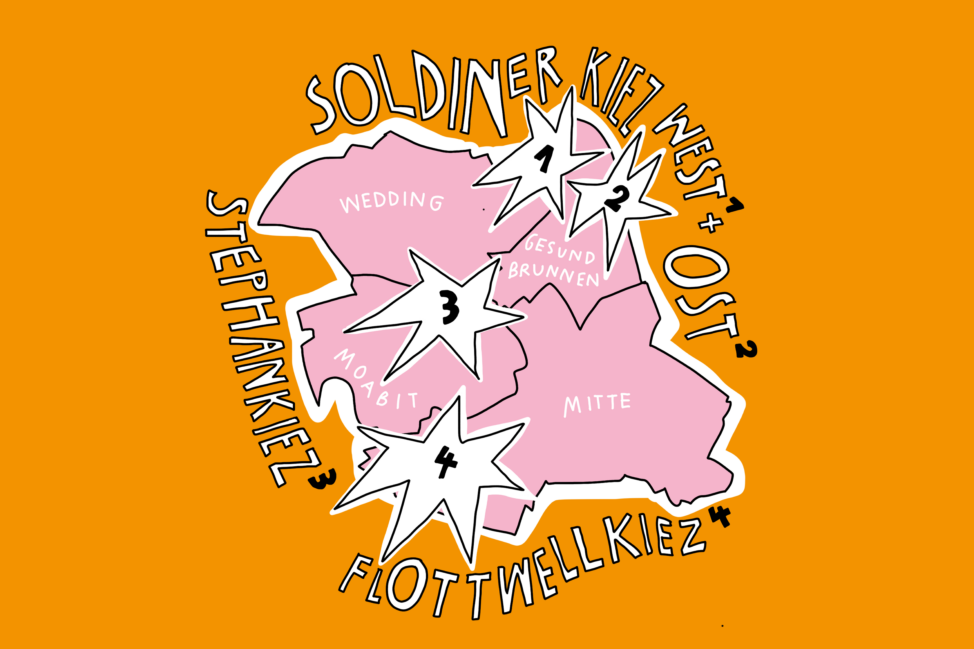
In these four Kieze, 2,026 Kiezblocks will be implemented:
- Flottwellkiez
- Soldiner Kiez East
- Soldiner Kiez West
- Stephankiez
The Mitte District Office also provided information on this (see press release dated July 17, 2026).
What criteria were used to select the four Kieze?
Based on the new guidelines, Kieze were selected whose plans can only be implemented through traffic management measures . Therefore, deviating from the original prioritization of Kieze based on their suitability for implementing “Kiezblock” measures, new criteria had to be defined for selecting the four “Kiezblock” concepts to be implemented. Narrow streets are suitable for traffic management through one-way streets, as they encourage drivers to follow the prescribed direction of travel. In wider streets, narrowing measures serve exactly this purpose, e.g., through extended sidewalks or median strips.
Why are many of these concepts no longer suitable for implementation in 2026 given these new guidelines and budget cuts?
Many of the neighborhood block concepts that have been developed cannot be implemented under the current conditions, as they rely on numerous measures that physically redirect motor vehicle traffic. The use of one-way streets without additional structural measures would likely have only a minor impact in those areas. However, this does not change the fact that these neighborhood block concepts are fundamentally sound here. This applies to: Arkonaplatz, the Auguststraße neighborhood, the Böttgerblock, Brunnenstraße West, the Gartenstraßenkiez, Gendarmenmarkt, Gesundbrunnen, Grenzstraße, Kameruner Straße, Lehrter Straße, the Malplaquetkiez, Moabit West, the Uferstraßenkiez, and Wilsnacker Straße.
So what happens next?
Once the four Kiezblocks have been implemented, we will evaluate whether the intended goal has been achieved or whether more extensive structural measures are needed to make the streets safer and quieter. The evaluation will be conducted through traffic observations and counts, as well as on-site surveys in each Kiez. After a period of adjustment to the new traffic situation, we’ll be back on-site with our cargo bike—just like last spring—and look forward to hearing your feedback. Have the traffic conditions and your sense of safety changed? Has it gotten better, worse, or stayed about the same? We look forward to talking with you. At News we’ll post the dates.
Today is a special day.
The fact that this year only Kiezblocks will be implemented in the Flottwellkiez, Soldiner Kiez Ost, Soldiner Kiez West, and Stephankiez neighborhoods does not mean that all the work—and your involvement in the participatory process—regarding the remaining Kieze was in vain. The neighborhood block concepts that have been developed are ready for implementation at a later date, once funding has been secured.